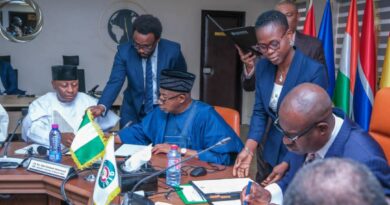

The Bala Wunti Question
By Usman Abdullahi Koli
Nigeria woke up to another of those thunderous figures that have a way of shaking the public square before the details have even settled. This time it was ₦210 trillion, a number so enormous that it instantly dominates imagination and travels faster than the explanations that must eventually follow. According to reports of proceedings at the Senate Committee on Public Accounts, lawmakers have summoned former officials of the national oil company, including Mele Kyari, a former chief financial officer Umar Ajia Isa, and the former head of National Petroleum Investment Management Services, Bala Wunti, to appear and explain entries contained in the financial records of the Nigerian National Petroleum Company Limited between 2017 and 2023.
The figure itself emerged from two separate items flagged in audit reports. One relates to ₦103 trillion said to represent cumulative spending by joint venture partners through cash calls over several years, while the second concerns ₦107 trillion recorded in the company’s financial statements as “sundry receivables” allegedly owed by banks and other entities. When these two figures are placed side by side, they immediately form the kind of number that leaps out of a headline and spreads across the country within minutes, generating alarm, speculation, and sometimes conclusions before the technical meaning of the figures has been properly unpacked. The figures are, without exaggeration, shocking. Even seasoned observers of public finance may pause for a moment and wonder how such a colossal number appears in a single conversation and how exactly the arithmetic behind it was constructed before explanations are laid out in full.
Anyone who has followed the workings of Nigeria’s petroleum industry understands that petroleum accounting is rarely simple. The sector operates within a web of long-term investments, complex contractual arrangements, multi-party joint ventures, and project expenditures that often run for years before they are fully reconciled in financial statements. Figures that appear inside audit reports are frequently aggregated values representing transactions accumulated over time or accounting classifications that still require reconciliation rather than straightforward descriptions of missing money.
None of this removes the responsibility of explanation, and it must be said clearly that the Senate committee is right to demand clarity. Oversight is a constitutional duty and one of the most important mechanisms through which public institutions are held accountable for the management of national resources. When auditors identify issues or inconsistencies within financial records, the correct response is explanation supported by documentation so that the public can understand the real meaning behind the numbers presented before them.
Yet there is another responsibility that must also be remembered in moments like this, and it is the responsibility to distinguish between a question and a verdict. Legislative hearings exist precisely because questions must be asked and answers must be tested against facts. Committees review audit reports, raise queries, and invite officials to provide clarifications while documents are examined and figures interpreted by those who handled them. Many issues that appear alarming at first glance are eventually resolved when the accounting details are properly understood, while others may indeed reveal deeper problems that demand corrective action. The essential point is that hearings represent the beginning of inquiry rather than its conclusion.
It is within this atmosphere that the name of Bala Wunti has entered the center of the conversation. To some observers, he is simply one among several former officials who have now been asked to appear before the committee. To others who have followed the trajectory of Nigeria’s petroleum sector over the years, his name carries a professional history that deserves to be understood before judgments are pronounced.
Bala Wunti’s journey within the petroleum industry was not the result of a sudden political elevation. It was shaped over decades of work inside a sector that demands both technical competence and managerial discipline. Rising through responsibilities that required a deep understanding of investment management, exploration financing, and operational oversight, he eventually occupied strategic roles within Nigeria’s upstream petroleum administration where decisions often involve billions of dollars and partnerships with international oil companies.
Professionals who operate in that environment understand the weight of such responsibilities. The oil industry is neither forgiving nor casual about leadership positions because the scale of its operations leaves little room for error. Those who spend long careers within it are constantly evaluated through the results of their work and through the professional scrutiny that surrounds every major project and financial decision.
For many colleagues and industry watchers, Wunti’s reputation developed within that demanding environment where competence rather than noise often determines who rises to positions of responsibility. Over time he became known as a technocrat whose professional path reflected the rigors of the energy sector rather than the turbulence of partisan politics.
Beyond professional credentials, there is also the matter of personal character, which in the Nigerian context often carries moral significance. In many parts of northern Nigeria, people sometimes describe a person by saying that his life is guided by the fear of his Creator. It is a description that has been attached to Bala Wunti more than once by individuals who have encountered him closely. The phrase does not claim perfection because no human being is beyond error, but it conveys a sense of moral caution and personal discipline that shapes how a person approaches responsibility.
For many who have known him either from afar or through professional contact, the present controversy therefore arrives with genuine surprise. It is not because questions should never be asked or because public officials should be shielded from scrutiny, but because the image many people formed about him over the years appears difficult to reconcile with the picture that a headline might suggest. Those who have watched his professional conduct closely often insist that Bala Maijama’a Wunti belongs to a class of technocrats whose strength lies in quiet diligence rather than flamboyant visibility, a man who built his path through careful work and professional discipline rather than through shortcuts that sometimes color public life.
The institution at the center of the present questions, the Nigerian National Petroleum Company Limited, sits at the heart of Nigeria’s economic life and its financial records naturally reflect the scale and complexity of that position. The company’s operations span exploration activities, joint venture partnerships, global energy investments, and numerous financial arrangements that stretch across several years and multiple jurisdictions. When auditors examine such an institution, they inevitably encounter figures that appear enormous when isolated from the broader accounting framework within which they exist.
Over these six years, Nigeria’s federal budgets were: ₦7.44 trillion in 2017, ₦9.12 trillion in 2018, ₦8.92 trillion in 2019, ₦10.59 trillion in 2020, ₦7.99 trillion in 2021, and ₦10.74 trillion in 2022, with 2023 at about ₦10.49 trillion. Combined, the total federal budget for the six years comes to roughly ₦57.3 trillion, with annual averages around ₦9.88 trillion. Total federal revenues during the same period ran from ₦5.08 trillion in 2017 to ₦10.49 trillion in 2023, and expenditures from ₦7.44 trillion to ₦21.83 trillion. Even adding all revenues and expenditures together, the total is far below the ₦210 trillion now being cited, and simple arithmetic alone demands explanation.
During Bala Wunti’s leadership at the National Petroleum Investment Management Services (NAPIMS), the department responsible for managing Nigeria’s upstream investments and joint venture assets, the records show profits of roughly ₦9 trillion. Importantly, the same Senate Committee on Public Accounts that is now raising questions had previously acknowledged the department’s performance and financial records under his tenure.
This is precisely why many observers now find themselves asking an additional question that goes beyond the numbers. What exactly has changed? If the committee once acknowledged the department’s financial performance and records during the same period under review, Nigerians deserve to understand the basis for this sudden shift in tone and position. Public oversight must remain credible, and credibility requires consistency.
Legislative committees, by the very nature of their constitutional role, cannot afford to appear as though they are playing with the minds of the public or allowing national institutions to become stages for political theatre. Oversight should illuminate facts, not create confusion or inadvertently damage reputations that have been built over decades of professional service.
For that reason, it is only fair that the committee clearly explain the basis of its present assertions so that Nigerians can understand whether the concerns arise from newly discovered evidence, technical accounting interpretations, or something else entirely. What must be avoided is the perception that public hearings are being used either to generate headlines, attract political attention, or prematurely cast shadows on individuals whose professional records have previously been acknowledged by the same institution now raising questions.
And in the midst of this staggering ₦210 trillion discussion, perhaps it is worth pausing for a quiet smile. When a human mind attempts to picture two hundred and ten trillion naira, even the most seasoned accountant might feel the sudden urge to check if their calculator has gone on strike. One can almost imagine Bala Wunti sipping tea quietly somewhere, watching the headlines float by, wondering if anyone had asked the numbers how they felt about being so dramatically misrepresented. Perhaps the committee is dancing to the tune of someone else, because if not, how did they even think of this figure and call it unaccounted for? How can even Nigeria survive? Amid the humor, there remains a serious hope that when the numbers are eventually explained and the dust settles, the truth will emerge with clarity and the name of Bala Maijama’a Wunti will stand where many who know him have always believed it belongs: on the side of integrity, diligence, and quiet professional honor.
Usman Abdullahi Koli
mernoukoli@gmail.com.